
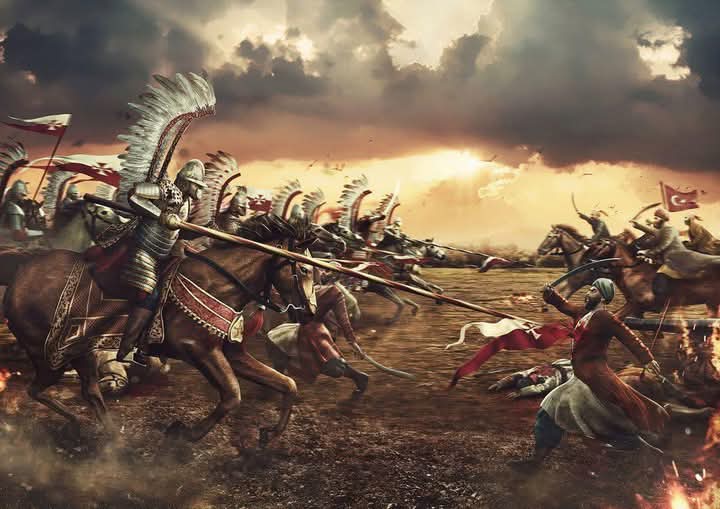
The Last Charge of Christendom: How the Siege of Vienna Saved Europe from -the Ottoman Islamic regime
The survival of European Christian civilization is often credited to the pivotal alliance between the Holy Roman Empire and the Polish-Lithuanian Commonwealth. Historical scholars suggest that had these powers failed to hold the line, the continent might have faced a demographic and religious transformation similar to that of Constantinople. In that scenario, the widespread massacre of Christian populations and the conversion of historic cathedrals into mosques—a pattern seen during the Ottoman conquest of the Byzantine Empire—could have become the reality for Central and Western Europe.
The Precipice of Collapse
By September 1683, the city of Vienna was the “Golden Apple” of the Ottoman Empire—the gateway to the heart of Europe. For two agonizing months, a massive Ottoman force of 120,000 soldiers had encircled the city. Inside the walls, the situation was dire:
- Decimated Defense: The Viennese garrison was exhausted, with only a fraction of its infantry remaining.
- The Ticking Clock: Ottoman sappers had successfully tunneled under the city walls. Though several explosive charges were discovered and defused at the last second, the fortifications were crumbling.
- The Desperate Plea: A lone messenger risked everything to slip through enemy lines, carrying a frantic appeal for aid to the Polish-Lithuanian Commonwealth and the Holy Roman Empire.
The Largest Cavalry Charge in History
Just as the remaining defenders were being pinned down, facing what appeared to be their final stand, a silhouette appeared on the Kahlenberg hills. Emerging from the dense forest to the thunderous cheers of the infantry below, King Jan III Sobieski of Poland arrived at the head of a massive relief force.
What followed was a spectacle of military might that remains unparalleled:
- 18,000 Cavalry: An enormous wave of horsemen poured over the ridge.
- The Winged Hussars: At the tip of the spear were 3,000 Polish Winged Hussars, elite heavy cavalry adorned with iconic wooden frames holding eagle feathers that created a terrifying whistling sound as they charged.
- The Impact: This remains the largest single cavalry charge in recorded history. The sheer momentum of the heavy Polish lancers shattered the Ottoman lines, turning a potential conquest into a panicked rout
A Legacy in History and Fiction
The victory at Vienna effectively ended the Ottoman Empire’s 300-year expansionist drive into European territory. The cultural and historical weight of this event is so profound that it served as the direct inspiration for J.R.R. Tolkien’s depiction of the Battle of the Pelennor Fields in The Lord of the Rings. The arrival of the Rohirrim at the Siege of Minas Tirith mirrors the “miraculous” arrival of the Polish cavalry.Following the triumph, King Jan Sobieski III sent a letter to the Pope, humbly paraphrasing Julius Caesar’s classic boast to reflect the religious significance of the victory:
“Venimus, vidimus, Deus vicit” — “We came, we saw, God conquered.“
Today, the cuirass of a Polish Hussar stands as a silent witness to the day the tide of history was forcibly turned, preserving the religious and political landscape of modern Europe.